Operating and maintaining an access network requires significant staffing and organizational resources, and the demands continue to grow as technology becomes more complex. Additional challenges, such as increasing cybersecurity requirements, a shortage of skilled professionals, and the ongoing need for software updates and lifecycle management, further increase the operational burden. At the same time, growing investment needs and pressure on prices and margins make it increasingly challenging to operate cost-effective and futureproof networks.
This is where Broadband Connectivity as a Service, or BCaaS, comes in.
BCaaS offers an attractive alternative to the traditional model of operating a network in-house. Regional providers benefit from a modern, cloud-native network platform and automated operational processes without having to build a complex operations organization or develop additional specialist expertise in network operations.
But what does Broadband Connectivity as a Service mean?
Broadband Connectivity as a Service (BCaaS) is an operating and service delivery model in which an external partner provides and operates the broadband connectivity platform and its associated operational processes as a managed service. This may include, for example, the access network, home WiFi, and OSS/BSS components. The regional provider retains control over its customer relationships, products, and marketing.
While the platform, operations, and lifecycle management are centrally orchestrated, automated, and continuously enhanced, the regional provider can focus its own resources more effectively on developing its offering, improving the customer experience, and acquiring and retaining customers.
BCaaS can therefore help regional telecommunications and internet service providers simplify their service portfolios, bring new offerings to market faster, and increase operational efficiency.
However, this operating model involves more than deciding who handles individual tasks. The underlying network architecture is equally important. The benefits of centrally orchestrated and largely automated operations can be realized most effectively when the network and system architecture is also consistently designed around standardization, modularity, and scalability.
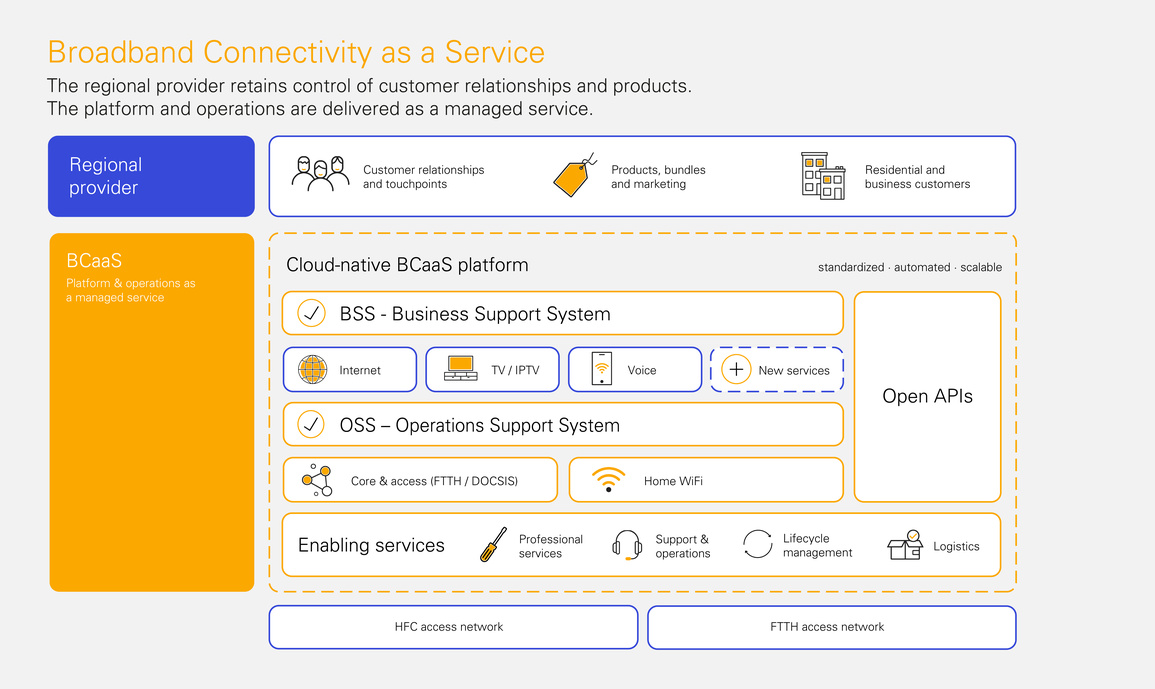
An example target architecture for BCaaS
One possible target architecture is based on a cloud-native, software-based, modular platform. Instead of operating numerous legacy systems separately, core functions and processes are more closely integrated, standardized, and orchestrated through shared platforms.
Virtualization, software-defined networking, and cloud-native technologies make it possible to increasingly decouple network functions from proprietary hardware and manage resources more flexibly. Automated processes also provide the foundation for implementing configurations, updates, and lifecycle management centrally and efficiently.
This architecture can connect different layers of broadband connectivity, from the access network and home WiFi to OSS/BSS and the associated operational processes. What matters most is how the components work together within a standardized platform that supports automation, rather than any single technology.
This creates a technical foundation that allows capacity to be provisioned as needed, new services to be introduced faster, and different technologies to be operated more efficiently. The architecture thus supports the very capabilities that are central to a BCaaS model: scalability, automation, standardization, and continuous improvement.

Would you like to learn more about Broadband Connectivity as a Service?
Please call or email me. I look forward to hearing from you.
+41 78 606 99 41
daniel.schurter@mybn.ch